
Mark A. Garcia, “Of Doorposts and Hinges: Calvin on Union with Christ.” (2009).
In this unpublished paper, Garcia argues Calvin saw both justification and sanctification flow from a single union with Christ: “The blessings of union with Christ, then, are distinct, inseparable, and simultaneously bestowed” (5). It is not the case that Justification is the basis for union with Christ, but the reverse. The question then arises: how does one make sense of Calvin’s statement that justification is “the main hinge on which religion turns,” “the sum of all piety,” and even “the foundation for all godliness?” Garcia argues that the meaning of “religion,” piety,” and “godliness” are important here. When Calvin speaks of religion here he is not speaking in terms of a theological system but in terms of the Christian life Theologically, justification is not the ground of sanctification, but experientially it is. “To see this, one needs only to turn to Calvin’s brilliant treatment of justification in his Institutes, Book 3, and note that whenever he uses language that suggests, at first sight, that justification is central to salvation or the Christian faith, or that justification causes sanctification, one finds that he has this experiential, not theological (as distinguished above), connection in view. In fact, in places where he does turn to the theological relationship, and one perhaps expects him to ground sanctification in justification, one discovers instead that he turns not to justification but to union with Christ, even in the midst of his treatment of justification” (12).
But what does it mean to say that justification is the experiential foundation for Christian piety? Garcia explains: “justification by faith alone affords the believer the necessary and essential confidence before God, the secure and stable foundation of a pure conscience, that spurs him on in the pursuit of piety and walking in holiness.” And why is Calvin concerned to maintain this? Because he desired to combat the Roman Catholic claim that the Protestant view of justification resulted in a legal fiction with no real impact on holy living.
Garcia, Mark A. “Imputation and the Christology of Union with Christ: Calvin, Osiander and the Contemporary Quest for a Reformed Model.” Westminster Theological Journal 68 (2006): 219-51.
In this article Garcia challenges those who think they can replace the concept of imputation with that of union with Christ (N. T. Wright, Don Garlington, Richard Hays, etc.). Garcia objects that these interpreters too often fail to probe what the nature of union with Christ is, which is a necessary step prior to determining whether imputation is necessary. As a way of answering the question of the nature of the union, Garcia examines Calvin’s controversy with Osiander, an extreme Lutheran. In the course of this study, Garcia observes that Calvin brought together his view of union with Christ with his debate with the Lutherans regarding their insistence on the ubiquity of Christ’s human nature and its presence in the Lord’s Supper. In contrast to the Lutherans, the Reformed held that what is true of the natures of Christ are attributed to the Person. Analogously (but only analogously since our union with Christ is not hypostatic), the righteousness of Christ is attributed to those in union with him on the grounds that they are in union with him. But to say this is simply to say that Christ’s righteousness is imputed to us. In other words, imputation works along with union with Christ rather than apart from it. It is an important theological concept because it reminds us that even though there is union “two distinct beings are always in view.”
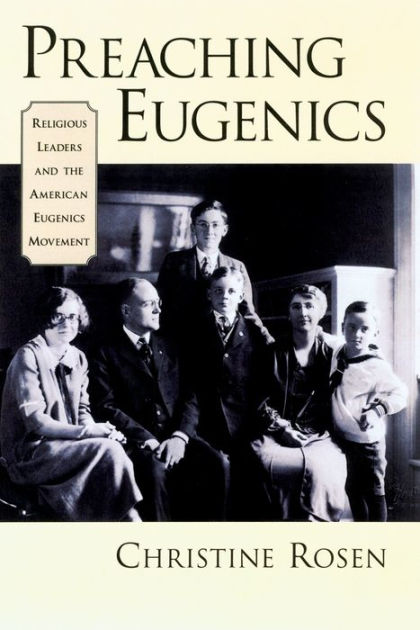 Certain kinds of religious leader gravitated toward eugenics in the early twentieth century, ministers anxious about the changing culture but also eager to find solutions to its diagnosable ills. Theirs was a practical spirituality better understood in terms of worldviews than theologies. Many of the religious leaders who joined the eugenics movement were well-known, even notorious, for their lack of coherent doctrinal vision; of one Congregationalist advocate for eugenics it was said, “He is not a theologian in the ordinary sense, for he loves flowers more than botany.” Of another, a well-known Baptist minister, one critic noted the impossibility of constructing even a preliminary image of his beliefs: “No painter who ever lived could make a picture which expressed the religion of the Rev. Harry Emerson Fosdick.”
  Gonzalez, Justo L. The Story of Christianity: The Reformation to the Present Day. Revised edition. New York: HarperOne, 2010.