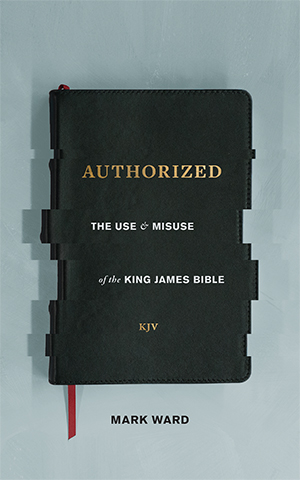
I thought the funniest line in Mark Ward’s new book Authorized was his take on a common cliche found in the acknowledgments of many theological books:
All remaining errors—I’ve waited so long to say this—are of course the reviewers’ fault: they either missed the mistakes or failed to persuade me that I was wrong. (142)
Since my name occurs in the preceding list of reviewers, I think it only right to correct one of the errors that slipped through. 🙂
I’m pushing for “their” as a third person indefinite (not specifying singular or plural) pronoun—if that’s what the NOW corpus and other tools prove people are using. (72)
I would argue that since Bible translations are translations of an ancient document, we should preserve as much as possible in the receptor language forms of speech that reflect that of the ancient culture and avoid forms of speech, when possible, that obscure the ancient culture. I’m not arguing that the Bible should be made to sound archaic by using older forms of English. I’m arguing that the Bible should not read like a newspaper article. For instance, I’m reading the Aeneid right now. I’m reading a modern translation because I don’t want the additional barrier of working through older English to understand the text. But even in a modern translation, the Aeneid doesn’t sound like the newspaper. I think Mark agrees with this. See page 70.
I would apply this insight to the use of “their.” The Bible was written in a patriarchal society, and there is some value in recognizing that their use of pronouns reflected this aspect of their culture rather than trying to force our cultural sensibilities onto the text. At some point, the generic “his” may disappear from English usage, but at present, it is still in use. On such matters, I think Bible translations should trail the English vernacular.
Mark might respond by pointing out that this is why we have multiple translations. Mark makes a good case for using multiple Bible translations, and he argues that we should give up the quest to find the best translation. I agree with his point to a great degree. I benefit from using multiple translations, and if I were asked to name the best of those that I currently use I might tell you that I really like the ESV in 1 Peter, but not so much in 1 Corinthians, where I prefer the HCSB. I really enjoy reading the Psalms in the Lexham English Bible because it translates יהוה as Yahweh, but I don’t like its translation of Genesis 1:26-27. So I do get Mark’s point. And yet, there is a benefit to settling on a default translation that you primarily memorize from or for a church to select a translation that it will primarily use in its services. There are some versions that are more suitable for this role and others that should play a niche role. I would argue that versions that tend toward the more formal side of the translation scale are better suited for this role. I think Mark might agree with this since he noted at one point that more formal translations have a kind of logical priority over functional ones.